
Table of Contents
Introduction
In today’s fast and busy life, many people feel stress, fear, and negative thoughts. Sometimes we overthink small problems and feel worried without reason.
Positive thinking is not about ignoring problems. It is about training your mind to stay calm, focused, and hopeful even during difficult situations.
If you want to understand how to maintain a positive mindset during difficult life changes, you can also read our guide on creating positive energy during life transitions.
The good news is — positive thinking is a skill. Anyone can learn it with simple daily exercises.
In this guide, you will learn:
- Easy positive thinking exercises
- Daily habits to reduce stress
- Practical methods anyone can follow
- Simple techniques for beginners
If you are searching for simple positive thinking exercises, this guide will help you step by step
What is Positive Thinking?

Positive thinking means focusing on the good aspects of life rather than always concentrating on problems. It does not mean ignoring difficulties, but it helps you stay hopeful and solution-oriented in challenging situations Mayo Clinic, 2023.
It does not mean everything is perfect. It means:
- You look for solutions
- You stay hopeful
- You control your thoughts
Your thoughts affect your life. If your thinking changes, your life also changes.
Why Positive Thinking is Important
Positive thinking helps in many ways:
- Reduces stress
- Improves mental health
- Builds confidence
- Helps in better decision making
- Improves relationships
- Increases motivation
Positive thinking plays an important role in improving overall well-being. It helps reduce stress, improves mental health, builds confidence, and supports better decision-making. People with a positive mindset are more likely to stay motivated and handle challenges effectively (Harvard Health Publishing, 2022).
Benefits of Positive Thinking
- Better mental health
- Less stress and anxiety
- Better sleep
- Strong confidence
- Good relationships
Signs of Negative Thinking
Before improving, you must understand negative thinking.
Common signs:
- Overthinking small problems
- Fear of failure
- Always expecting bad results
- Comparing yourself with others
- Feeling low without reason
If you notice these, don’t worry. You can improve step by step.
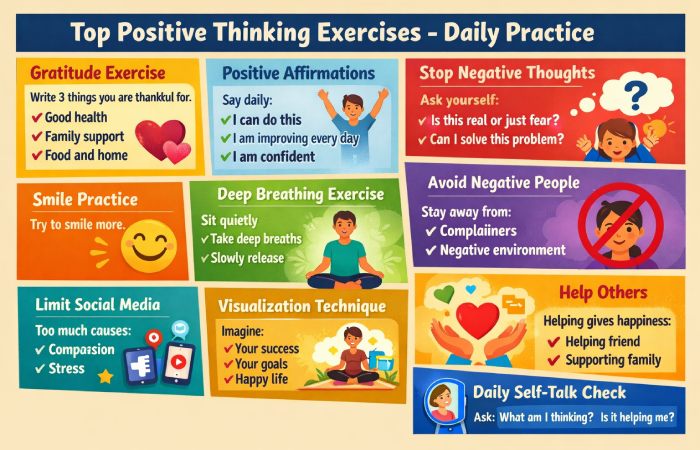
Top Positive Thinking Exercises – Daily Practice
- Gratitude Exercise
Every day, write 3 things you are thankful for.
Example:
- Good health
- Family support
- Food and home
This trains your brain to focus on good things.
- Positive Affirmations
Say positive sentences daily:
- I can do this
- I am improving every day
- I am confident
Repeat in morning or before sleep.
- Stop Negative Thoughts
When a negative thought comes:
Ask yourself:
- Is this real or just fear?
- Can I solve this problem?
Replace it with a positive thought.
- Smile Practice
Even if you don’t feel good, try to smile.
It sends signals to your brain and improves mood.
- Deep Breathing Exercise
- Sit quietly
- Take deep breath
- Slowly release
Do for 5 minutes.
This reduces stress and clears mind.
- Avoid Negative People
Stay away from:
- People who complain always
- Negative environment
Choose positive company.
- Visualization Technique
Close your eyes and imagine:
- Your success
- Your goals
- Happy life
This increases confidence.
- Limit Social Media
Too much social media creates:
- Comparison
- Stress
Use less and focus on real life.
- Help Others
Helping others gives happiness.
Example:
- Helping friend
- Supporting family
This builds positive mindset.
- Daily Self-Talk Check
Ask daily:
- What am I thinking?
- Is it helping me?
Change negative self-talk.
Positive Thinking Exercises for Anxiety & Stress
- Breathing exercise
- Writing worries
- Replacing fear thoughts
Morning Routine for Positive Thinking
- Wake early
- Gratitude
- Affirmations
- Light exercise
Night Routine for Positive Mind
- No phone before sleep
- Write 1 good thing
- Relax breathing
Positive vs Negative Thinking
| Factor | Positive Thinking | Negative Thinking |
| Mindset | Hopeful | Fearful |
| Focus | Solutions | Problems |
| Energy | High | Low |
| Confidence | Strong | Weak |
| Results | Growth | Stress |
Daily Routine for Positive Thinking

| Time | Activity |
| Morning | Affirmations + gratitude |
| Afternoon | Focus on work |
| Evening | Help others / relax |
| Night | Reflection + positive thoughts |
Adding simple fitness habits to your daily routine can also support positive thinking. You can explore these easy fitness tips and strategies for a healthy lifestyle”
7-Day Positive Thinking Challenge
| Day | Task |
| Day 1 | Gratitude |
| Day 2 | Affirmations |
| Day 3 | Stop negative thoughts |
| Day 4 | Help someone |
| Day 5 | Meditation |
| Day 6 | No social media |
| Day 7 | Reflection |
Positive Thinking for Students
- Students today face a lot of pressure. Exams, marks, competition, and expectations can create stress and fear.
- Positive thinking helps students stay calm and focused.
- For example, before an exam, instead of thinking “I will fail”, try thinking “I prepared well, I will do my best.”
This small change in thinking improves confidence.
How students can practice:
- Take deep breaths before studying
- Avoid overthinking results
- Focus on daily progress, not perfection
- Take short breaks to relax the mind
When the mind is calm, learning becomes easier.
Positive Thinking at Work
Work pressure is common today. Deadlines, targets, and responsibilities can make people feel stressed.
Positive thinking helps you stay balanced and avoid mental pressure.
Instead of thinking “This work is too much”, try “I will complete this step by step.”
Simple ways to stay positive at work:
- Do one task at a time
- Avoid negative discussions
- Take small breaks
- Stay organized
A calm mind helps you work better and faster.
Common Myths About Positive Thinking
Many people misunderstand positive thinking. Let’s clear some common myths:
- Myth: Positive thinking means life has no problems
Truth: Problems will always be there, but you handle them better - Myth: Only happy people can think positive
Truth: Anyone can learn it with practice - Myth: It works instantly
Truth: It takes time and daily effort
Positive thinking is not magic, it is a habit.
Scientific Benefits of Positive Thinking
Positive thinking is not just an idea. It also affects your brain and body.
When you think positively:
- Your brain feels relaxed
- Stress levels go down
- You make better decisions
- Your focus improves
A peaceful mind leads to better life choices.
Along with mental exercises, physical activities like simple workouts can also improve your mood and reduce stress. You can check our guide on back exercises with dumbbells for beginners.
Tools for Positive Thinking
You don’t need anything expensive, but some simple tools can help.
- Journaling: Write your thoughts daily
- Meditation apps: Help you relax and focus
- Habit trackers: Track your daily progress
These tools make your journey easier and more consistent.
Best Exercises for Beginners
If you are just starting, don’t try everything at once.
Start with simple exercises:
- Gratitude writing (write 3 good things daily)
- Deep breathing (5 minutes daily)
- Positive affirmations (say good things to yourself)
These are easy but very powerful if done daily.
Common Mistakes to Avoid
Many people stop because of small mistakes.
Avoid these:
- Expecting fast results
- Ignoring real problems
- Not practicing regularly
- Comparing yourself with others
Change takes time. Be patient with yourself.
Tips for Better Results
If you want real improvement, follow these simple tips:
- Practice every day
- Stay consistent
- Start small
- Keep learning
- Stay around positive people
Small daily actions create big long-term results.
Real Life Example
A student was always stressed before exams. He used to feel nervous and think negative thoughts.
Then he started small changes:
- Daily affirmations
- Deep breathing
- Positive thinking
After a few weeks:
- His stress reduced
- Confidence increased
- He performed better in exams
This shows that small habits can create big changes over time.
FAQs
Can positive thinking change life?
Yes, it improves mindset, decisions, and confidence.
How long it takes?
You can see changes in few weeks with daily practice.
Is it difficult?
No, simple exercises can help.
Conclusion
Positive thinking is not magic. It is a daily practice.
You don’t need special skills or money. Just small habits every day can change your mindset and life.
Start today with one exercise and slowly add more.
Small steps → Big change