
Table of Contents
Introduction
In India, education is changing fast.
Earlier, classrooms had only:
- Chalk
- Blackboards
- Books
But now, things are different.
Schools, colleges, and coaching centers are slowly moving to digital teaching.
This is where smart infovision comes into the picture.
Many people search for:
- smart infovision
- smart infovision luc
- benchmark digital board
- smart board for teaching
But they are often confused.
What is it?
How does it work?
Is it useful in India?
This guide will explain everything in very simple words.
What is Smart Infovision?
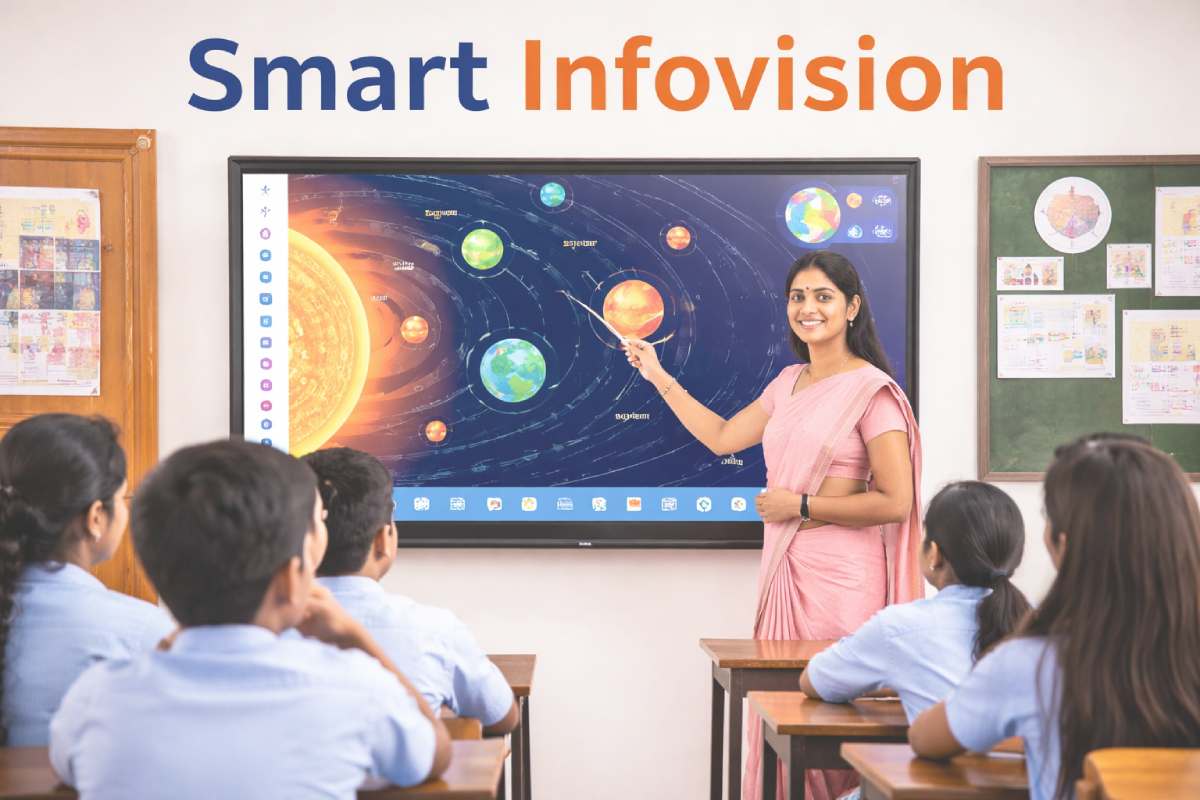
Smart infovision is a type of digital teaching system.
It usually includes:
- Interactive display (smart board)
- Teaching software
- Touch screen system
- Audio-visual content
It helps teachers to:
- Explain topics visually
- Show videos and animations
- Write on screen using touch or pen
In simple words:
It is a modern classroom board that replaces the blackboard.
Why Smart Infovision is Growing in India
India is a very large country.
There are millions of students studying in:
- Schools
- Colleges
- Coaching centers
In many places, the number of students is increasing every year.
Because of this, the education system is under pressure.
Traditional teaching methods are not always enough now.
Problems in Traditional Classrooms
1. Large Class Size
In many Indian schools:
- One teacher handles 40–80 students
- Sometimes even more in government schools
This creates real problems:
- Teacher cannot give personal attention
- Weak students get ignored
- Bright students also feel slow learning
Not every student learns at the same speed.
So, many students fall behind.
2. Limited Attention Span
Students today are different. Good physical health also supports learning, and understanding fitness basics helps students stay active and focused.
They use:
- Mobile phones
- Videos
- Social media
Because of this:
- They are used to fast and visual content
- Long lectures feel boring
In traditional classrooms:
- Teacher talks
- Students listen
After some time:
- Students lose focus
- Start thinking about other things
This affects learning quality. Overuse of mobile phones and social platforms can reduce focus, similar to the effects discussed in social media habits.
3. Less Practical Learning
Old teaching style depends on:
- Textbooks
- Blackboard writing
- Notes
But many subjects need more than that.
For example:
- Science needs experiments and visuals
- Geography needs maps and images
- Maths needs step-by-step explanation
Without visuals:
- Students only memorize
- They don’t understand deeply
This is a big problem in Indian education.
4. Chalk Dust Problems
Chalkboards are still used in many schools.
Daily use of chalk creates:
- Dust in the classroom
- Dirty boards and hands
This can cause:
- Cough
- Throat irritation
- Breathing issues
Teachers suffer the most because they use it all day.
Health issues in classrooms can affect students in many ways, similar to other physical discomforts like fluid imbalance in the body.
5. Time-Consuming Teaching Method
In traditional teaching:
- Teachers write everything on the board
- Draw diagrams again and again
This takes a lot of time.
Less time is left for:
- Explanation
- Doubt solving
6. Less Student Participation
In many classrooms:
- Only teacher speaks
- Students just listen
Students don’t get chances to:
- Come forward
- Answer actively
- Interact
This makes learning passive and boring.
Now, Schools Want Better Learning
Education is changing in India.
Parents and schools now expect:
- Better results
- Modern teaching
- Easy understanding
They don’t want only marks.
They want:
- Real knowledge
- Practical learning
- Skill development
This is the main reason for change.
A modern classroom also needs an effective teacher who can use digital tools properly.
How Smart Infovision Solves These Problems
1. Helps in Large Classrooms
Smart infovision uses:
- Big screens
- Clear visuals
Even students sitting at the back can:
- See clearly
- Understand better
One teacher can handle many students more effectively.
2. Improves Student Attention
Instead of only talking:
- Teachers show videos
- Use animations
- Display colorful content
This makes class:
- Interesting
- Engaging
Students stay focused for longer time.
Using visual learning along with positive thinking techniques can improve focus and memory.
3. Makes Learning Practical
With smart boards, teachers can show:
- Real-life examples
- Animated explanations
- Step-by-step solutions
Students understand, not just memorize.
4. Clean and Healthy Classroom
No chalk is used.
So:
- No dust
- No dirty boards
Better for both students and teachers.
5. Saves Time in Teaching
Teachers can:
- Open ready-made lessons
- Use saved content
- Avoid rewriting everything
More time for:
- Explanation
- Interaction
6. Encourages Student Participation
Students can:
- Come to the board
- Solve problems
- Interact with content
Learning becomes active, not passive.
7. Supports Digital India Growth
India is moving towards:
- Digital education
- Online learning
- Smart classrooms
Smart infovision supports this change.
Many schools are upgrading their classrooms.
India is moving towards digital education under the Digital India initiative.
8. Helps in Competitive Exam Preparation
In India, students prepare for:
- NEET
- JEE
- Government exams
Smart teaching helps in:
- Quick revision
- Clear explanation
- Better understanding
9. Works for Hybrid Learning
Today, learning is both:
- Offline (classroom)
- Online (home)
Smart infovision allows:
- Recording lessons
- Sharing digital content
Students can learn anytime.
Simple Summary
Earlier classrooms:
- Chalk
- Blackboard
- One-way teaching
Now classrooms:
- Smart boards
- Visual learning
- Interactive teaching
This is why smart infovision is growing fast in India
Reasons for Growth
| Reason | Explanation |
| Digital India push | Government focus on digital learning |
| Smart classrooms | Schools upgrading infrastructure |
| Better understanding | Students learn faster with visuals |
| Online + offline mix | Hybrid education is growing |
| Competitive exams | Need better explanation methods |
What is Smart Infovision LUC?
Smart infovision LUC is often searched online.
It usually refers to:
- A model or version of smart infovision system
- A specific product line used in classrooms
- Could include updated features or software
Important:
There is no public verified official standard definition of “LUC” in all cases.
So always:
- Check official product details
- Verify from seller or provider
Smart Board for Teaching – How It Works
A smart board for teaching is simple to use.
Basic Working
- Teacher turns on the board
- Connects to computer or built-in system
- Opens lesson (PDF, PPT, video)
- Writes on screen using touch or stylus
- Students watch and learn
Features of Smart Infovision Boards
| Feature | Benefit |
| Touch screen | Easy writing like mobile |
| HD display | Clear visuals |
| Internet support | Access online content |
| Multimedia | Videos, audio, images |
| Screen recording | Save lessons |
| Multi-user support | Multiple students interact |
Benchmark Digital Board vs Smart Infovision
Many people compare:
- benchmark digital board
- smart infovision
Let’s understand clearly.
Comparison
| Feature | Smart Infovision | Benchmark Digital Board |
| Usage | Smart classrooms | Smart classrooms |
| Interface | Touch-based | Touch-based |
| Content support | Yes | Yes |
| Internet use | Yes | Yes |
| Installation | Wall-mounted | Wall-mounted |
| Cost range | Medium to high | Medium to high |
| Target users | Schools, coaching | Schools, institutes |
Both are similar in purpose.
Difference depends on:
- Brand
- Features
- Software
- Price
Advantages of Smart Infovision in India (Detailed Explanation)
1. Better Understanding
In many Indian classrooms, students find it hard to understand only from books.
When teachers use smart infovision, learning becomes more clear.
Students can see:
- Videos that explain topics step by step
- Diagrams that show structure clearly
- Animations that make concepts easy
For example:
Science topics like the human body or solar system become much easier to understand when shown visually.
Because of this:
- Students remember longer
- Less confusion
- Less need to repeat topics again and again
2. Time Saving for Teachers
Teaching on a blackboard takes time.
Teachers have to:
- Write everything manually
- Draw diagrams again and again
With smart infovision:
- Lessons are already prepared
- Teachers can open files quickly (PPT, PDF, videos)
- No need to write everything
This saves time and energy.
Teachers can focus more on:
- Explaining concepts
- Solving doubts
3. Interactive Learning
Traditional classrooms are mostly one-way.
Teacher speaks → Students listen.
But with smart boards:
- Students can come to the board
- Solve questions on screen
- Write answers using touch
This makes learning:
- More active
- More interesting
- Less boring
In India, many students feel shy.
This method helps them participate more.
4. No Chalk Dust (Health Benefit)
In normal classrooms:
- Chalk dust spreads in air
- Teachers and students breathe it
This can cause:
- Throat irritation
- Allergies
- Breathing issues
Smart infovision removes this problem.
- No chalk
- No dust
Clean and healthy classroom environment.
5. Digital Storage and Reuse
One big advantage is saving content.
Teachers can:
- Save lessons
- Record classes
- Reuse the same content later
This is very useful for:
- Revision classes
- Absent students
- Exam preparation
Students can also learn again without confusion.
6. Supports Modern Education System in India
India is moving towards:
- Digital learning
- Smart classrooms
- Online + offline education
Smart infovision supports this change.
It fits well with:
- CBSE and state boards
- Coaching institutes
- Online teaching platforms
7. Improves Student Interest
Many students lose interest in long lectures.
But when using:
- Videos
- Images
- Interactive tools
Students feel:
- More engaged
- More curious
- More focused
This is very important in India where class sizes are large.
Activities like yoga and mindful practices can also improve concentration and classroom engagement.
Disadvantages of Smart Infovision (Important to Know – Expanded)
1. High Cost for Many Schools
One of the biggest problems.
Smart infovision systems are not cheap.
Costs include:
- Board price
- Installation
- Software
- Maintenance
Many small schools in India cannot afford it easily.
2. Dependence on Electricity
Smart boards need:
- Continuous power supply
In many areas of India:
- Power cuts are common
If electricity goes:
- Teaching gets interrupted
- Board becomes unusable
3. Need for Teacher Training
Not all teachers are comfortable with technology.
They need to learn:
- How to use the board
- How to open digital content
- How to manage files
Without training:
- System may not be used properly
- Teachers may avoid using it
4. Technical Issues and Maintenance
Like any electronic device, problems can happen:
- Screen not working
- Touch issues
- Software errors
Schools need:
- Technical support
- Regular maintenance
This can increase long-term cost.
5. Over Dependence on Technology
Too much use can also be a problem.
If teachers depend only on digital tools:
- Basic teaching skills may reduce
- Students may depend too much on visuals
Balance is important..
6. Internet Requirement for Full Use
Some features need internet:
- Online videos
- Updates
- Cloud storage
In some areas:
- Internet is slow or unstable
This limits full use of the system.
7. Not Always Needed for Every Subject
Some subjects work fine with simple teaching.
For example:
- Basic language learning
- Simple theory topics
In such cases, smart boards may not give extra value.
Simple Thought
Smart infovision is helpful.
But it is not perfect.
Best use happens when:
- Teachers are trained
- Schools have budget
- Technology is used in balance
Then it becomes a powerful tool for education in India.
We should also be honest.
| Problem | Explanation |
| High cost | Not affordable for all schools |
| Electricity needed | Power cuts affect usage |
| Training required | Teachers must learn |
| Maintenance | Needs technical support |
Where Smart Infovision is Used in India
- Private schools
- Coaching centers
- Colleges
- Training institutes
- EdTech classrooms
Is Smart Infovision Good for Small Schools?
Depends on budget.
Good if:
- School has funds
- Wants modern teaching
- Focus on quality
Not ideal if:
- Very low budget
- No electricity backup
- No trained teachers
Cost of Smart Infovision in India
Price varies.
Approximate Range
| Type | Price (INR) |
| Basic setup | ₹50,000 – ₹1,00,000 |
| Mid-range | ₹1,00,000 – ₹2,50,000 |
| Advanced | ₹2,50,000+ |
Price depends on:
- Screen size
- Software
- Brand
- Installation
Smart Infovision vs Traditional Teaching
| Feature | Traditional | Smart Infovision |
| Teaching style | Chalk & talk | Visual + digital |
| Student interest | Medium | High |
| Speed | Slow | Fast |
| Interaction | Limited | High |
| Content | Books only | Multimedia |
Important Tips Before Buying
If you are planning:
Check These Points
- Screen quality
- Touch response
- Software support
- Warranty
- After-sales service
- Demo availability
SEO Tip (For Your Website Use)
You can naturally use keywords like:
- smart infovision
- smart infovision luc
- benchmark digital board
- smart board for teaching
Use them in:
- Headings
- Paragraphs
- FAQ
- Table
But don’t overuse.
Reference (For Research Understanding)
You can refer to:
- Government Digital India initiatives
- EdTech trends reports
- School digital adoption studies
(Use general reference style, not fake links)
FAQ Section
- What is smart infovision used for?
It is used for digital teaching in classrooms.
- Is smart infovision good for students?
Yes, it improves understanding with visuals.
- What is smart infovision luc?
It may refer to a specific version or model. Always verify details.
- Is benchmark digital board same as smart infovision?
They are similar but may differ in brand and features.
- Can small schools use smart boards?
Yes, if budget and infrastructure allow.
Conclusion
Education in India is changing.
From chalkboards to digital boards, the journey is clear.
Smart infovision is part of this change.
It helps:
- Teachers teach better
- Students learn faster
- Classrooms become interactive
But it is not magic.
Schools must:
- Use it properly
- Train teachers
- Maintain systems
If used correctly, it can make learning simple, clear, and modern.