
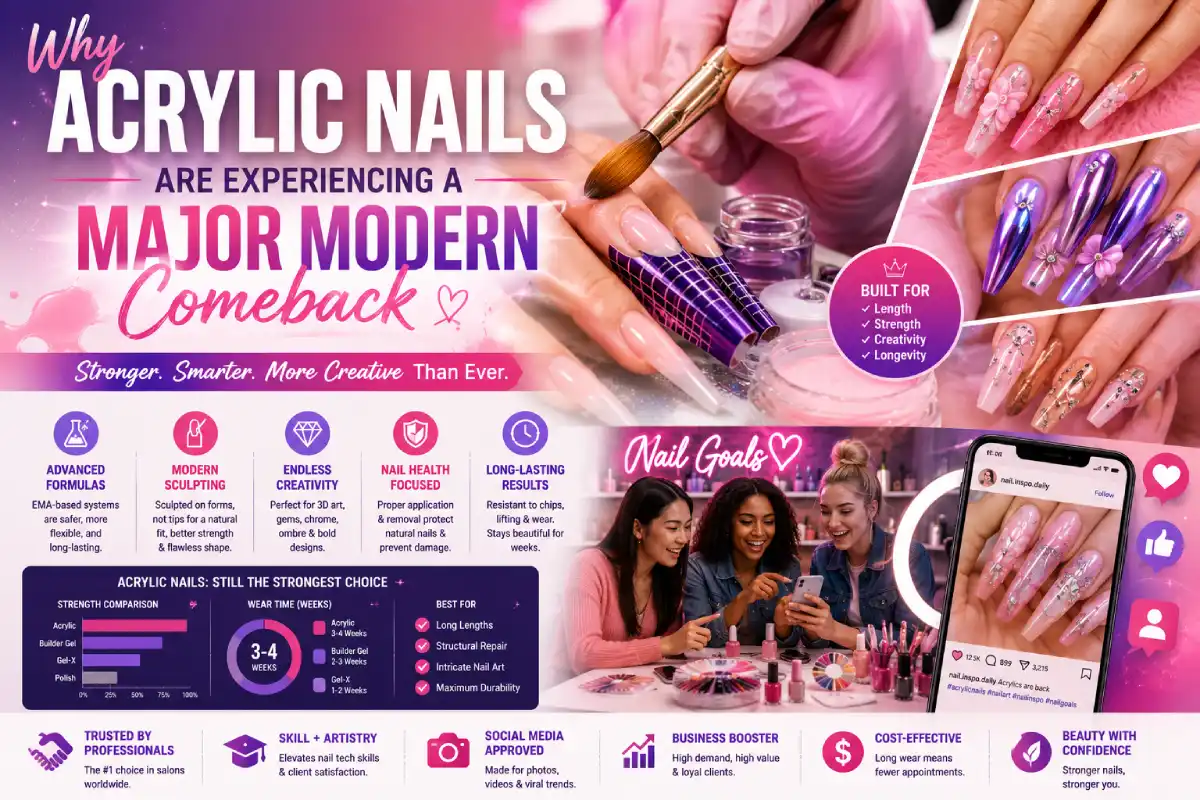
In between the return of the Y2K fashion and the increase of nail-related content on social networking sites, acrylics were no longer the trend you felt ashamed about, but rather became the trend you boasted about. This is isn’t just nostalgia rearing it’s head either. It is a structure that improved unintentionally as everyone scrambled to acknowledge it.
Table of Contents
Formula has quietly gotten much better
Advancements on the chemical front of acrylic may not be so apparent to you as a salon client, but you definitely feel the difference. EMA is short for ethyl methacrylate, and it’s the monomer used in all professional salon acrylic systems. It’s a different chemical compound than the MMA formulations that were responsible for damaging some people’s natural nails. When you use a high-quality acrylic system made with EMA, like acrylic nail powder by deenti, flexibility and durability are built in.
The powders have come a long way, too. Ultra-fine polymer powders and highly refined pigment particles allow powders to be mixed with liquid monomer more easily, and when the two are blended, the resulting bead can be shaped seamlessly without dragging for those crucial first seconds. With less air captured in the bead due to a high-quality polymer powder, you’ll notice fewer bubbles on the final, filed, and polished nail. The powders in a professional EMA system are formulated with UV stabilizers to prevent yellowing from UV exposure. A well-formulated acrylic will be bubble free, resist lifting, and stay true to color for the wear of the enhancement.
The sculpted nail vs. the old-school tip
The acrylic nails people saw in the early 2000s were dense, same-thickness extensions stuck over the natural nail plate using a metal or plastic tip. These extensions can lead to water or other material getting trapped beneath, which can be a breeding ground for fungus and bacteria. They’re also heavy – pulling at the nail bed.
Now? Techs sculpt extensions from acrylic (a mix of powders and liquid monomer that forms a paste) and adhere them directly to the natural nail plate using a more-sculptable paper or reusable foam tip called a form. This eliminates the shelf and all its associated pitfalls.
Social media turned nails into a portfolio
Apps like Instagram, TikTok, and Pinterest didn’t create demand for nail art – they amplified demand and changed what clients think to ask for. A 3D sculpted design with gems, texture sweeps, or raised chrome details simply requires a base that won’t flex or chip under the weight of whatever’s going on top of it. Soft gel and builder gel systems are hit or miss here. Acrylic is not.
It’s the push for sometimes over-the-top, photogenic nail designs that escalated skill development to the point where the average shop in a city center is now offering you things that would have been considered specialty work a decade ago. A client saves a photo of their nail art reference that took someone hours to design, and their nail tech will reproduce it within an hour. Acrylic is the standard platform where this kind of work is concerned. It holds a line, won’t bleed color over, and once it’s cured, it’s not going anywhere.
The damage conversation, addressed directly
The myth that acrylics destroy natural nails continues to float around, but it’s virtually obsolete. The only causes of damage are aggressive prep that overrides the nail plate’s natural integrity and forceful (not proper soak-off) removals. Neither of these things has anything to do with the acrylic itself. They are application and removal mistakes; products are innocent by default.
Prep has evolved dramatically thanks to modern e-files. Dehydrating and gently exfoliating natural nails with an e-file (as opposed to invading the nail bed) has become a regular practice of a skilled professional. A product only seeps into the outer layer of the nail plate; it doesn’t penetrate through the nail and to the nail bed. When it comes time to switch looks, a savvy tech carefully soaks the product in acetone to dissolve (not mechanically). The thresholds of nail-bed health are the education of the technician, and the habits of the client – not the product.
The myth that acrylics destroy natural nails continues to float around, but it’s virtually obsolete. The only causes of damage are aggressive prep that overrides the nail plate’s natural integrity and forceful (not proper soak-off) removals. Neither of these things has anything to do with the acrylic itself. They are application and removal mistakes; products are innocent by default.
As we get older, changes in nail strength and texture can also become more noticeable, just as hair and nails changed after 30 can affect how people approach their beauty and maintenance routines.
Longevity still wins for the right client
Gel-X and builder gel systems have found their place. They are best suited for short-to-medium length work, clients with really sensitive skin who already know they react to monomer, and those who really, truly need something with the most flexible removal to try and help them take it off at home before we get there. That’s a real segment.
But if clients want length past their fingertips, if we’re talking about structural repair on a broken nail, or if they need something to stay intact for three to four weeks without needing a fill, acrylic is still the best option for accomplishing these things. Hopefully, this cements it: Acrylic has always been the strongest option individually for each of these scenarios, but taken together, they parallel the vast majority of what we do in the salon.
The comeback isn’t a trend cycle completing itself. It’s an industry holding onto a format that still does things no replacement has fully matched. The clients who tried the other thing and came back already know why.