
By Dr. Quoc N. Dang, DO
Medical Director, WeightLossPills.com
I have been practicing obesity medicine long enough to remember when the therapeutic toolbox was thin: orlistat, which blocked fat absorption and caused side effects that made patients dread eating a normal meal, and phentermine, a short term sympathomimetic that worked reasonably well for a few weeks and then became a regulatory headache. For most of my career, the honest answer to a patient asking about pills for weight loss was a reluctant one. That is no longer the case.
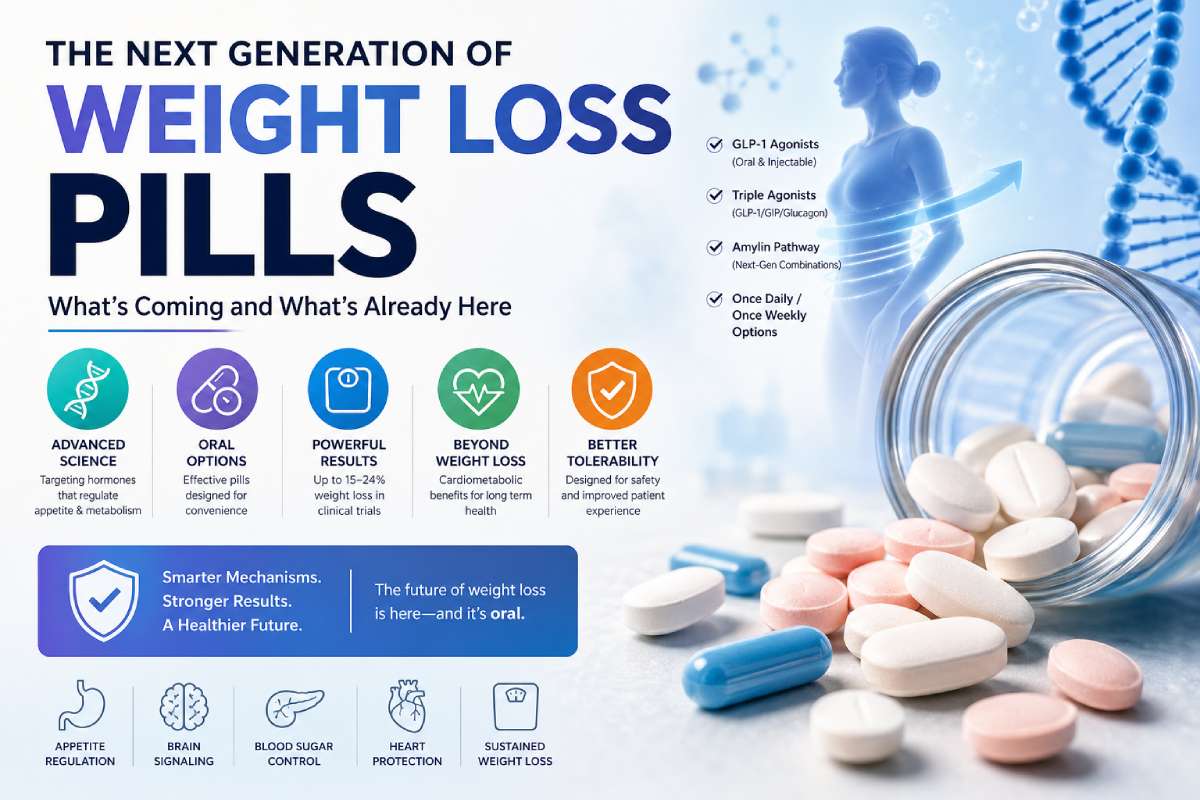
The past three years have shifted my thinking in a way that residency and fellowship never did. Injectable GLP-1 receptor agonists like semaglutide and tirzepatide showed us that the gut hormone axis could be leveraged to produce 15 to 20 percent body weight loss in clinical trials, numbers that previously belonged only to bariatric surgery. But injectables carry a ceiling: patients who are needle averse, uninsured, or managing multiple daily medications often cannot or will not use them. The question the field has been racing to answer is whether we can achieve comparable results from a pill taken once daily. The evidence coming in suggests we are very close.
Table of Contents
Oral GLP-1 Agonists: The Mechanism Problem, Mostly Solved
GLP-1 receptor agonists are peptides, and peptides are ordinarily destroyed in the stomach before they reach systemic circulation. The innovation that enabled oral semaglutide for diabetes was the addition of a small absorption enhancer called SNAC, which transiently raises local gastric pH and allows semaglutide to slip across the gastric mucosa. That formulation works, but it requires fasting conditions, precise timing, and a relatively modest dose ceiling.
Orforglipron and danuglipron take a structurally different approach. They are small molecules, not peptides, designed from the ground up to activate the GLP-1 receptor without the delivery constraints that limit the peptide class. Orforglipron can be taken with or without food. In the phase 3 ATTAIN trials, participants taking the highest dose lost approximately 8 to 9 percent of body weight over 36 weeks, with cardiovascular and glycemic benefits consistent with what we see from the injectable class. Danuglipron posted similar numbers in phase 2 before Pfizer paused its broader program to optimize the formulation further. These are not incremental gains. An oral agent that produces 8 percent weight loss with once daily dosing and no injection requirement represents a genuine therapeutic advance, particularly for the patients I see who flatly refuse a pen.
Retatrutide: Three Receptors, One Molecule
If oral GLP-1 agonists represent an evolution in delivery, retatrutide represents an evolution in mechanism. It is a triple agonist: GLP-1, GIP, and glucagon receptors all activated by a single molecule. Tirzepatide already demonstrated that the dual GLP-1 plus GIP combination outperformed pure GLP-1 agonism in head to head comparisons. Adding glucagon receptor activity raises the ceiling further by increasing energy expenditure directly, not just by suppressing appetite.
Phase 2 data for retatrutide showed weight loss in the range of 17 to 24 percent over 48 weeks depending on dose, with a dose response curve that was frankly striking. The glucagon component raises legitimate questions about hepatic glucose production in people with diabetes, and the clinical program is navigating that carefully. But for patients without significant glucose dysregulation, a mechanism that simultaneously reduces caloric intake and raises basal metabolic rate is exactly the combination that has eluded obesity pharmacology for decades. Phase 3 results are expected in 2025 and 2026, and I am watching them more closely than anything else in my pipeline right now.
Amylin Pathways: Cagrilintide and the Satiety Ceiling
Amylin is a pancreatic peptide that slows gastric emptying and contributes to postmeal satiety, but it works through a different neural circuit than GLP-1. Pramlintide, an older amylin analog, was approved years ago and produced modest weight loss of 2 to 3 percent in most studies. The problem was that it required multiple daily injections and the magnitude of effect did not justify the burden.
Cagrilintide is a long acting amylin analog designed for once weekly dosing, and its story gets more interesting in combination. CagriSema, the fixed ratio combination of cagrilintide and semaglutide, produced weight loss of approximately 15 percent in phase 2 over 32 weeks, outperforming either agent alone. The rationale makes biological sense: GLP-1 and amylin act on overlapping but distinct satiety circuits, and combining them may push past the ceiling that either reaches individually. Novo Nordisk has a phase 3 program underway, and if the results hold, this could give us a combination product that matches or exceeds tirzepatide’s efficacy without the complexity of a small molecule triple agonist.
What Actually Makes These Drugs Different
When patients ask me how these compare to the older generation, I make a distinction that often gets lost. The older weight loss pills, phentermine, topiramate, bupropion naltrexone, acted primarily on the central nervous system to suppress appetite through dopaminergic, noradrenergic, or opioid pathways. They worked for some patients, and combinations like Qsymia produced respectable results. But they carried cardiovascular signals, mood effects, and a host of precautions that made prescribing them feel like a negotiation.
The newer agents, the GLP-1 agonists and their successors, work through receptors expressed in the gut, the brain, the pancreas, and the cardiovascular system. Rather than forcing appetite suppression through a blunt neurochemical signal, they modulate the body’s own satiety and metabolic signaling in ways that are far better tolerated and, in the case of semaglutide, demonstrably cardioprotective. The SELECT trial showed a 20 percent reduction in major cardiovascular events in people with obesity and established cardiovascular disease. No older weight loss pill came close to that.
The weight loss pills coming through the pipeline now carry that same mechanistic logic forward. They are not appetite suppressants in the traditional sense. They are metabolic modulators that happen to produce weight loss as a primary outcome, with cardiometabolic benefits that are increasingly difficult to separate from the weight loss itself.
Who These Are Right For, and When I Prescribe Them
I do not lead with the newest or most complex agent for every patient. For someone with BMI above 30 and no complicating factors who wants to avoid injections, an oral GLP-1 agonist once approved will be my first conversation. For a patient with significant cardiovascular risk and limited injectable tolerance, the same. For someone who has already plateaued on semaglutide and whose BMI remains elevated enough to carry real health risk, retatrutide or CagriSema may eventually represent a reasonable next step, once we have phase 3 data and regulatory clarity.
The patients I think about most carefully are those who nearly reached a meaningful threshold with older therapies. Someone who lost 6 percent on phentermine topiramate and maintained it for two years is not a failure story. But if their blood pressure remains elevated, their sleep apnea is not fully resolved, and their primary care physician is asking about metformin, the question of escalating to a newer mechanism becomes a real clinical decision, not just a preference.
Where I Think This Is Going
I expect the next five years to produce a meaningful shift in how we think about the ceiling of pharmacological weight management. If retatrutide confirms 20 percent weight loss in phase 3 at tolerable doses, the gap between medications and metabolic surgery will narrow substantially for many patients. The combination approaches like CagriSema raise the possibility of personalized regimens where mechanism is matched to the patient’s specific metabolic profile, not just their BMI.
What I do not expect is that pills will fully replace injectables in the near term. Bioavailability constraints are real, and a drug taken once daily as a small molecule may not reach the tissue exposure of a weekly subcutaneous depot. But for a large segment of patients, an effective oral option changes the conversation entirely, especially in primary care settings where injectable prescribing requires more infrastructure and patient education than most practices can provide.
Obesity medicine is at a point I did not think I would see this early in my career. The science has outrun the reimbursement, the supply chains, and in some cases the clinical guidelines. My job right now is to stay close enough to the evidence to make good decisions for the person in front of me, which means reading phase 3 data carefully, resisting the pull of early enthusiasm, and remembering that the goal is sustained, clinically meaningful weight loss with an acceptable side effect profile. On that measure, the field is finally delivering.
Dr. Quoc N. Dang, DO, is a board certified physician and Medical Director at WeightLossPills.com, where he specializes in medically supervised weight management and GLP-1 therapy.